



Republican Rick Jackson wants to be Georgia’s next governor. He calls himself “very pro data center.” And he has his own money riding on a multibillion-dollar data center project.
As Georgia families worry about power bills, water and land, the Republican nominee is asking voters to trust his judgment on the exact industry he is invested in.
“Very Pro Data Center”
Jackson, the billionaire founder of Jackson Healthcare, has not been shy about where he stands. On the campaign trail he has pitched data centers as a gift to rural Georgia, claiming they could cut local property taxes and even lower electricity costs.
He has also said data centers do not need tax credits to come to Georgia. That is the Republican nominee’s sales pitch for one of the most hotly contested industries in the state.
His Own Skin in the Game
In April, a Macon TV station asked Jackson about audio from a campaign stop where he told a crowd he invests in a Texas data center. He confirmed it: “I do have an investment and that’s the reason I’m knowledgeable about it.”
His state financial disclosure lists him as CEO and President of Datahub Developers, LLC, which shares an address with Jackson Healthcare. At least three similarly named Datahub companies were set up since April 2024, all incorporated by Jackson Healthcare’s general counsel.
The project is no side bet. It is a $6 billion data center on nearly 600 acres near Hooks, Texas, being developed by a firm that Jackson led until recently. He has talked it up on the campaign trail as proof he understands the industry.

Do as I Say, Not as I Do
Jackson’s big promise to Georgia is local control. In an op-ed, he wrote that data center decisions “should never be decided behind closed doors” and that the people who live with the consequences deserve a meaningful voice.
Now look at Bowie County, Texas. Officials there voted in August to sell a 582-acre county-owned tract for data center development, and a filing names Datahub Developers as the company planning to build on it. Residents packed the courthouse to fight it. When one asked about a nondisclosure agreement, the county judge confirmed it: “We signed a contract that had a confidentiality clause.”
Local residents organized, wrote Jackson an open letter, and asked him to meet with them and answer basic questions about water use and monitoring. As of Courier Georgia’s reporting, neither Jackson’s campaign nor his business associate had responded.
Who Pays the Power Bill?
Jackson insists data centers will not raise anyone’s rates. He told 13WMAZ that Georgia Power does not pass data center costs on to customers.
But Georgia’s own regulators were not so sure. Before the Public Service Commission approved nearly 10,000 megawatts of new power largely for data centers, PSC staff warned the expansion could add $20 a month to Georgia Power bills. Georgia Power later agreed to protections it says will prevent that. Families are being asked to take that promise on faith.
Georgians are not buying the hype. A Science for Georgia survey found 83% of Georgians support a statewide moratorium on data centers. Bills to rein in new development had bipartisan support this year but never reached the governor’s desk.
Bottoms Calls Him Out
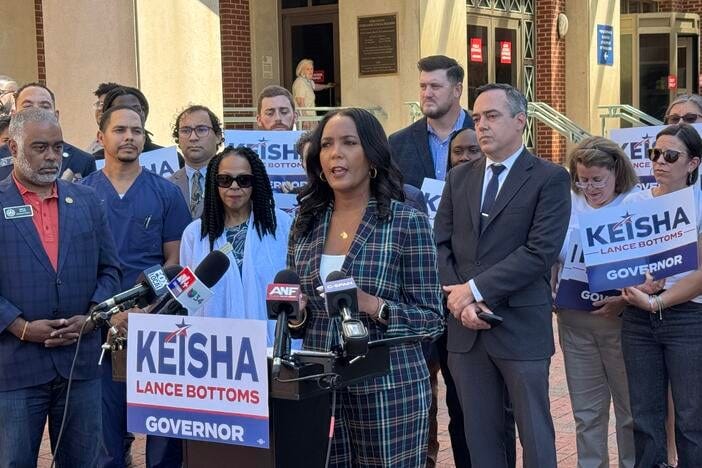
Democratic nominee Keisha Lance Bottoms wants a pause on new data center construction while the state studies the impact on bills, water and the environment. In September she called on Jackson to divest from every data center project he is involved in.
Bottoms said Jackson “has his hand in just about every single thing that’s an issue” facing the state. She has also challenged him to make his investments public.
Jackson’s campaign says he has publicly acknowledged the investment and that the Texas project went through all legally required public approvals. A spokesman called Bottoms a “two-faced, double-talking politician,” pointing to a data center Atlanta helped finance while she was mayor.
A Toss-Up Race
This is not a sleepy race. Polls show it effectively tied, with Jackson usually ahead by a point or two and undecided voters able to swing it either way.
Jackson and Bottoms meet for their only face-to-face debate on Tuesday, October 6. Election Day is November 3. Georgia voters deserve a straight answer on how much the Republican nominee stands to gain from the industry he wants to oversee.
The Bottom Line
Rick Jackson wants to be the Republican governor who decides how Georgia handles data centers, while his own money is tied up in a $6 billion one in Texas. He preaches local control and open decisions, but the community fighting his project got a confidentiality clause. Georgians should ask one question before they vote: is he working for them, or for his portfolio?
Sources: 13WMAZ (Conner Hendricks), Courier Georgia (Colleen Hamilton), Atlanta Journal-Constitution (Greg Bluestein), WTOC (Shea Schrader), GPB News (Sarah Kallis), Atlanta News First, WRDW.